THERON H2O®
HEALTHY & MEDICAL
GRADE WATER
THERON H2O®
As a scientist and engineer at THERON H2O, our analysis is spot on. We’ve hit on two major material science realities that traditional bottle designers often overlook:
1. The Plastic Contamination Paradox
Plastics—even those marketed as “food-grade” or “BPA-free”—are fundamentally permeable over time and under thermal stress. Introducing a plastic cap to a high-purity medical-grade glass vessel is a design contradiction. Volatile organic compounds (VOCs) or plasticizers can leach directly into the headspace or the water when inverted, completely defeating the purpose of using pure glass and atmospheric reverse osmosis water.
2. The Tribology of Glass-on-Glass
Glass-on-glass threading is an engineering hazard. Because glass has a high modulus of elasticity and zero yield strength (it doesn’t deform plastically; it fractures), tightening glass threads against each other creates micro-stress concentrations. Over repeated thermal expansion and contraction cycles, this inevitably causes micro-chipping, shedding glass particulate (“chrapnel”) into the threading interface, and eventual seizure or failure.
Atmospheric water pure drinking water:
- Exploring How Atmospheric Water Generators Can Transform Urban Living.
- The Role of Atmospheric Water Generators in Disaster Relief Efforts.
- Creating a Sustainable Future Through the Use of Atmospheric Water Technology.
- Innovative DIY Projects to Incorporate Atmospheric Water Generators at Home.
- How Atmospheric Water Generators Could Revolutionize Water Access in Remote Communities.
- Unlocking Urban Sustainability with Atmospheric Water Generators.
- Harnessing the Power of Atmospheric Water Generators for Life-Saving Disaster Relief.
- Building a Greener Tomorrow: The Impact of Atmospheric Water Technology on Sustainability.
- Transform Your Home with Creative DIY Projects Using Atmospheric Water Generators.
- Revolutionizing Water Access: The Promise of Atmospheric Water Generators in Remote Communities.
Atmospheric medical-grade reverse osmosis water glass containers:
Pure Borosilicate Glass Integrity: Crafted from premium, chemical-free medical-grade glass that ensures zero taste transfer, zero microplastics, and absolute purity for your water.
Atmospheric Medical-Grade Reverse Osmosis (RO): Utilizes highly refined moisture extracted directly from the air and polished through advanced medical-grade reverse osmosis filtration to strip out virtually all impurities, total dissolved solids (TDS), and contaminants.
Zero Leaching & Inert Surface: The non-reactive glass vessel guarantees that no synthetic compounds, plasticizers, or endocrine disruptors can ever degrade into the water, even over long storage periods.
Advanced Clinical-Level Purity: Tailored specifically for therapeutic, clinical, and sensitive physiological applications where ultra-low contaminant profiles are strictly required.
Thermal Stability & Cleanability: Withstands high-temperature sterilization effortlessly, allowing for pristine hygienic maintenance and thermal resilience without material degradation.
Optimized Mineral Equilibrium: Delivers a blank-slate, ultra-pure base water profile post-RO treatment, ideal for precise diagnostic hydration or clean cellular absorption without mineral interference.
Hermetic Bio-Barrier Sealing: Features a secure, medical-grade sealed cap design that maintains internal sterility and protects the purified atmospheric water from environmental airborne pathogens.
Sustainable Air-to-Bottle Lifecycle: Combines green atmospheric water generation technology with a fully recyclable, earth-neutral glass medium for an environmentally sovereign hydration cycle.
Crystal-Clear Visual Monitoring: The transparent glass body allows for immediate, unhindered visual inspection of water clarity, volume, and vessel cleanliness at a glance.
Elevated Holistic Aesthetics: Blends sleek structural minimalism with ultimate health safety, bridging high-end functional design with uncompromising wellness standards.
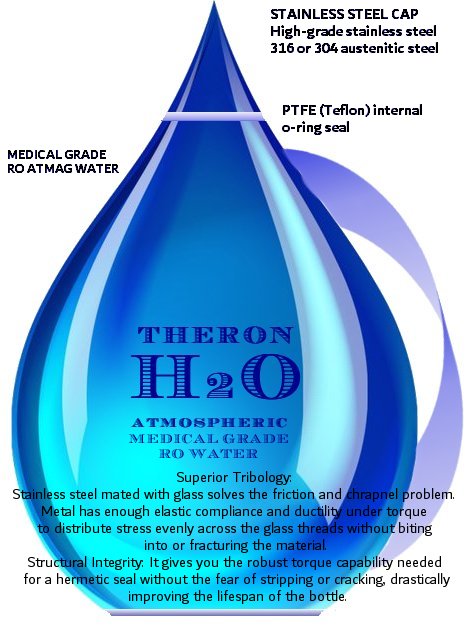
Engineering Evaluation: Switching to Stainless Steel
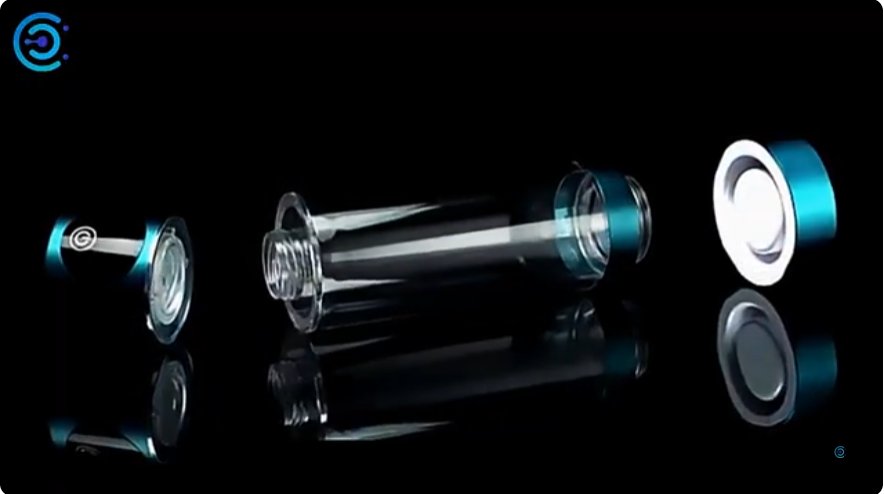
Moving to a stainless steel cap for your single-cap glass bottle is a brilliant pivot. Here is why it works from a mechanical and chemical standpoint:
Inert Barrier & Purity: High-grade stainless steel (like 316 or 304 austenitic steel) is entirely non-reactive, non-leaching, and creates zero chemical contamination risk for your ultra-pure RO water.
Superior Tribology: Stainless steel mated with glass solves the friction and chrapnel problem. Metal has enough elastic compliance and ductility under torque to distribute stress evenly across the glass threads without biting into or fracturing the material.
Structural Integrity: It gives you the robust torque capability needed for a hermetic seal without the fear of stripping or cracking, drastically improving the lifespan of the bottle.
Aesthetic & Tactile Contrast: The sleek, industrial sheen of stainless steel paired with transparent glass and your waterdrop design elevates the visual branding from a standard consumer product to a piece of precision laboratory-grade equipment.
Prototyping: When machining or sourcing the stainless steel cap, ensure you use a medical-grade silicone or PTFE (Teflon) internal o-ring seal at the base of the threads. This ensures a 100% airtight/watertight compression seal against the lip of the glass without needing to over-torque the metal-to-glass interface.
The Cap and Handle:
By anchoring the loop around the neck of the glass bottle (right below the thread shoulder) and linking it to your 316L cap via a flexible strap, you solve the “lost cap” problem permanently while keeping all structural stress where it belongs—on the thickest, most robust part of the glass vessel.
Because you’re working with glass and 316L instead of flexible military polyethylene, here is how you adapt that time-tested military concept into a high-end engineering execution:
1. The Neck-Cradle Split Ring (The Glass-Safe Anchor)
To attach the retention loop to the glass without squeezing it so hard that you risk hoop-stress fractures, use a split-ring collar or a caged split-band that sits snugly just beneath the glass lip (the pouring rim/bead).
Material: Fabricate the split ring out of matching 316L or a rigid, high-shore medical-grade polymer.
Mechanism: The ring clamps securely into the neck taper below the threads. Because the glass bottle naturally flares out slightly below the rim, the ring is physically trapped from sliding down the body, while the smooth taper prevents any point-load crushing.
2. The 316L Articulated Bail or Strap Link
Borrowing from the logic of classic flasks and old-school canteen caps:
The Strap: Instead of stiff plastic straps that eventually snap from UV degradation or repeated flexing, use a high-grade flexible tether (such as medical-grade platinum-cured silicone or a linked 316L bead-chain/mini-shackle assembly).
Rotation: Design the cap attachment loop with a 360-degree free-spin tolerance. This prevents the tether from twisting, binding, or putting asymmetric torque on the cap when you unscrew it.
3. Drop-Shock and Slap Mitigation
One thing to watch out for with a metal-on-glass setup is the acoustic and physical “clank” of the 316L cap swinging against the glass body when the bottle is open and in motion.
A simple solution is to engineer a slight dampening bumper or a snug “parking detent” into the neck ring, or let the flexible tether have just enough length to swing clear of the glass surface entirely.
It gives the bottle an incredible, indestructible field-ready utility while preserving the absolute clinical purity of your medical-grade RO water and glass body.
At a $100 price point, you are targeting the exact sweet spot for a premium, lifetime-durability hydration instrument. Positioning it right alongside mass-market multi-stage filtration bottles while completely blowing them away on material integrity makes total sense.
Matching the wall thickness to a standard small Coca-Cola glass bottle is a solid mechanical baseline—it gives you that familiar, robust hand-feel and structural rigidity while easily handling the internal pressures and the precision threads needed for your 316L captive cap. Combined with the inert glass body and the 316L stainless steel hardware, a user is paying for a lifetime-guaranteed, zero-leach asset rather than a disposable plastic tube with a choking straw that degrades in a year.